

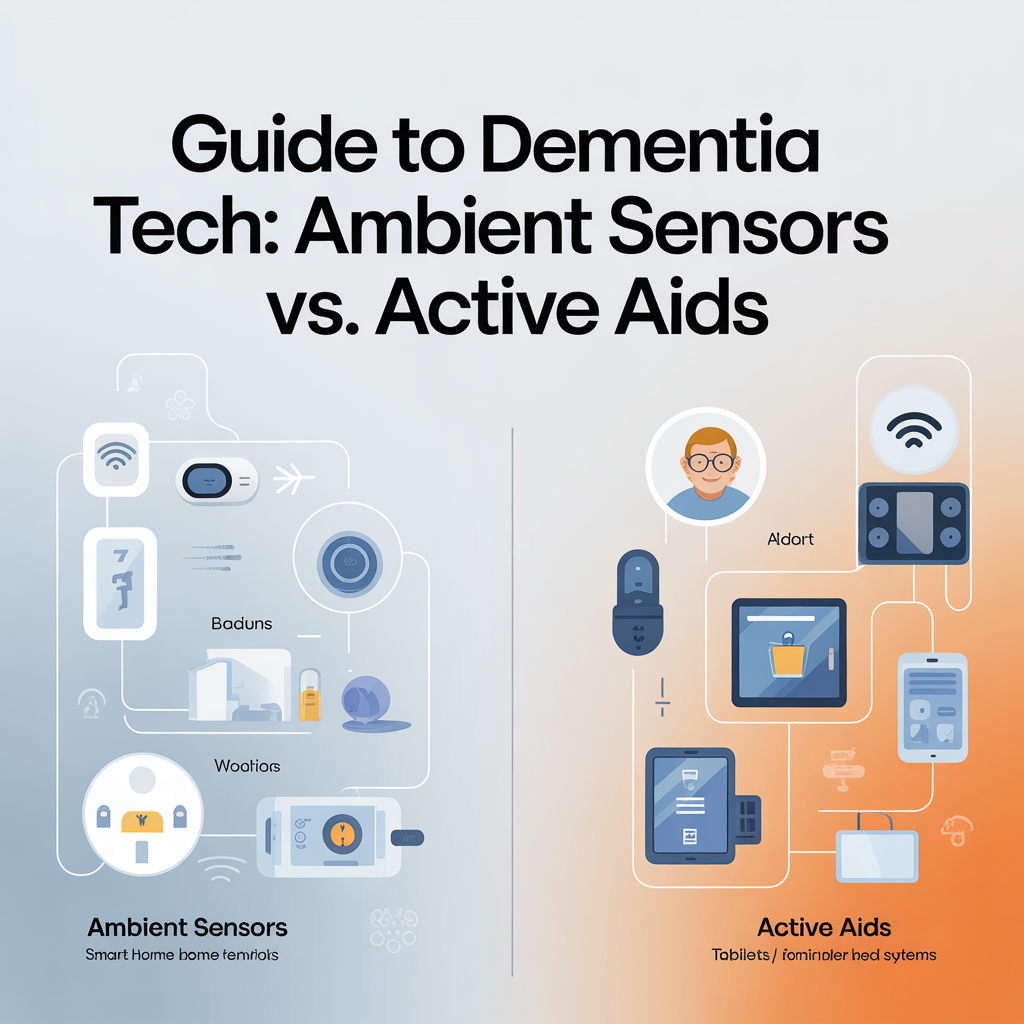
Guide to Dementia Tech: Ambient Sensors vs. Active Aids
When a loved one is diagnosed with dementia, families and care facilities often rush to find technological solutions.
The instinct is to buy GPS watches, panic buttons, and complex monitoring cameras.
However, a significant portion of this technology ends up unused in a drawer within weeks.
The failure isn’t in the technology itself, but in how it interacts with the person using it. In dementia care, the effectiveness of any tool is governed by the “Friction Rule.”
If a device requires a person with cognitive decline to remember to charge it, consciously press a button, or tolerate an unfamiliar sensation on their wrist, the friction is too high.
It will fail.
Understanding the dementia technology landscape means understanding the fundamental divide between Active Aids and Ambient Sensors.
Here is how to navigate the modern ecosystem of care technology to reduce caregiver burnout and preserve resident dignity.
1. The Friction Rule: Why Traditional Tech Fails
In the medical technology industry, “adherence”—getting a patient to consistently use a device or take a medication—is a massive hurdle.
For individuals with Alzheimer’s or other forms of dementia, this challenge is magnified.
As dementia progresses, sensory processing changes.
A watch that felt normal five years ago might suddenly feel heavy, restrictive, or frightening, prompting the wearer to take it off and lose it.
A traditional panic button requires the user to realize they are in danger, remember what the button does, and possess the motor skills to press it.
In a crisis, such as a fall or sudden disorientation, these steps are often impossible.
To build a truly supportive environment, we must categorize tools by how much effort they demand from the user.
2. Active Aids: The Engagement Layer
Active Technology requires the user to interact with it.
Because it involves friction, it is most effective in the early-to-middle stages of cognitive decline, or when specifically designed to soothe rather than monitor.
Active aids are not about safety; they are about maintaining routine, preserving cognitive reserve, and reducing isolation.
-
Restricted-Interface Tablets: Standard iPads are too complex. Purpose-built dementia tablets remove all confusing menus, replacing them with single-button navigation for video calls, familiar music, and family photo slideshows.
-
Automated Medication Dispensers: Rather than a simple pillbox, these devices visually and audibly alert the user when it is time for a dose, dispensing only the correct pills and locking the rest away. If a dose is ignored, the device automatically texts a family member or care nurse.
-
Socially Assistive Robotics: For individuals experiencing severe agitation or loneliness (often during the late afternoon “sundowning” period), robotic pets offer a profound solution. These are not toys; they are clinically designed to mimic the breathing, heartbeat, and response of a real animal, triggering the release of oxytocin and calming the nervous system without the unpredictable risks or care requirements of a live pet.
The Screen Time Nuance: Not all interaction is equal. Passive screen time (staring at a television for hours) has been shown to accelerate cognitive decline.
Active screen time—engaging with a simplified tablet, answering questions, or interacting with a robotic companion—exercises neural pathways and helps maintain cognitive health longer.
3. Ambient Sensors: The Monitoring Layer (Zero-Friction Care)
This is where the standard of care has fundamentally shifted.
Because of the adherence problem with wearables, the industry has embraced Ambient Assisted Living (AAL).
Instead of forcing the patient to adapt to a device, we adapt the environment to the patient. Ambient technology operates silently in the background.
It requires zero charging by the individual, zero active participation, and zero behavior change.
Older monitoring systems relied heavily on indoor cameras. While effective for safety, cameras strip individuals of their privacy and dignity, often causing severe paranoia.
Today’s ambient tech uses privacy-preserving sensors to turn a home or a long-term care room into a protective, invisible bubble:
-
Infrared and Motion Detectors: Strategically placed in hallways or bathroom frames to track movement patterns and room occupancy without capturing images.
-
Contact Sensors: Small, invisible magnets placed on medication drawers, refrigerators, or exterior doors that log when they are opened or left ajar.
-
Radar Vitals: Wall-mounted sensors that use radio waves to measure heart rate and respiration through clothing and blankets. This allows for continuous medical monitoring while the person sleeps normally.
4. The Paradigm Shift: From Reactive to Predictive Care
The most critical evolution in dementia technology is the shift from reactive alerts to predictive insights using AI.
A traditional fall pendant is reactive: it only helps after the bone is broken. Modern ambient sensors, however, gather continuous data to establish a person’s baseline behavior.
When AI analyzes this data, it looks for microscopic deviations called Digital Biomarkers.
By tracking these digital biomarkers, caregivers and facility directors can predict and prevent medical events before they happen.
-
Predicting a Fall: Smart flooring or radar sensors might detect that a person’s stride length has shortened by just two inches over the course of a week, or that their walking speed has decreased. This is a primary digital biomarker of a high fall risk. The system alerts the care team to intervene with physical therapy or a walker before the fall occurs.
-
Predicting an Infection: Motion sensors might detect a resident visiting the bathroom six times a night instead of their usual two. Frequent urination and disrupted sleep are leading indicators of a Urinary Tract Infection (UTI). In dementia patients, a UTI often causes sudden, severe delirium and hospitalization. By catching the bathroom frequency early, a simple course of antibiotics can be prescribed, entirely avoiding a crisis.
Summary: Designing the Right Ecosystem
Whether you are a family member trying to keep a parent safe at home, or a facility director looking to optimize staff efficiency, the technology strategy is the same:
-
Use Active Aids to foster joy, connection, and cognitive engagement.
-
Use Ambient Sensors to provide invisible, dignified safety and predict medical events before they escalate.
By understanding the Friction Rule and balancing these two layers, we can build environments that don’t just manage dementia, but actively support the human being experiencing it.
0 Comments