


The Stability Gap in Dementia Care
Why Incidents Repeat — and How Structured Visibility Reduces Risk
Executive Summary
Dementia care communities face persistent operational instability in the form of repeat falls, recurring behavioral escalation, wandering risk, cross-shift misalignment, and family concern.
Despite strong clinical expertise and dedicated staff, many communities struggle to sustainably reduce repeat incidents.
This paper introduces the concept of the Stability Gap — the structural gap between frontline observations and system-level visibility.
When behavioral contributors and environmental patterns are not captured consistently or reviewed structurally, instability compounds. Incidents repeat not because of negligence, but because of invisibility.
Closing the Stability Gap requires moving beyond event reporting toward structured pattern visibility, coordinated response alignment, and operational stability systems.
1. Dementia Care Is Structurally Different
Traditional risk frameworks in healthcare assume:
-
Linear cause-and-effect relationships
-
Acute event response
-
Clinical stabilization
Dementia care is fundamentally different.
Instability in dementia environments is often cyclical and pattern-based.
Common recurring instability drivers include:
-
Time-of-day vulnerability windows
-
Environmental overstimulation
-
Routine disruption
-
Communication inconsistency
-
Fatigue cycles
-
Approach variability between staff
Unlike acute medical events, many dementia-related incidents emerge gradually through repeating conditions.
When these cycles go unstructured, repetition becomes normalized.
2. Defining the Stability Gap
The Stability Gap exists when:
-
Meaningful behavioral contributors are observed but inconsistently captured
-
Documentation records events but does not illuminate repetition trends
-
Shift handoffs transmit information without structured context
-
Incident reviews focus on singular episodes rather than pattern clusters
In these environments, teams work hard and respond appropriately in the moment — yet instability continues.
The issue is not effort.
The issue is structural visibility.
3. The Cost of Repetition
Repeat instability has measurable consequences:
Operational Cost
-
Increased incident frequency
-
Time spent responding to recurring events
-
Leadership attention diverted to reactive management
Staff Impact
-
Reduced confidence
-
Burnout from repeated escalation cycles
-
Friction between shifts
Family Trust Erosion
-
Perception of preventable recurrence
-
Decreased confidence in coordination
-
Increased oversight scrutiny
Risk Exposure
-
Heightened liability vulnerability
-
Quality indicator decline
-
Increased documentation pressure
Instability compounds when repetition is not structurally addressed.
4. Why Documentation Systems Fail to Close the Gap
Most care documentation systems are designed for:
-
Regulatory compliance
-
Legal defensibility
-
Care plan updates
-
Billing alignment
They are not designed to:
-
Detect multi-day repetition cycles
-
Surface time-of-day clusters
-
Identify behavioral trigger trends
-
Connect environmental contributors to repeat events
An incident report may describe what happened.
It rarely answers:
“Has this pattern occurred four times this week under similar conditions?”
Without structured trend visibility, leadership must rely on memory, anecdote, or manual review.
This creates blind spots.
5. Behavioral Drivers of Instability
In dementia care, many risk events are behavior-linked.
Fall Vulnerability Often Connects To:
-
Exit-seeking attempts
-
Restlessness during transition periods
-
Bathroom urgency timing
-
Sleep fragmentation
-
Agitation windows
Escalation Cycles Often Connect To:
-
Approach inconsistency
-
Routine disruption
-
Overstimulation
-
Fatigue
-
Communication tone shifts
When these contributors are not captured in consistent language across shifts, teams cannot align.
This creates a loop:
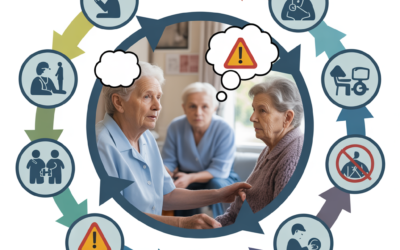
Trigger → Escalation → Resolution → No structured pattern review → Repeat
6. Monitoring vs. Stabilizing
Many communities invest in monitoring technologies.
Monitoring improves detection.
But detection does not automatically reduce repetition.
Monitoring answers:
“What just happened?”
Stability systems answer:
“Why does this keep happening?”
Without structured pattern alignment, monitoring can unintentionally reinforce reactive workflows.
True risk reduction requires pattern stabilization.
7. A Structured Stability Model
Closing the Stability Gap requires four structural pillars:
1. Standardized Observation Framework
Observations must use consistent language across roles and shifts.
This reduces interpretation variability and strengthens trend visibility.
2. Pattern Identification Across Time
Systems must illuminate:
-
Repetition clusters
-
Timing trends
-
Environmental contributors
-
Behavioral precursors
Without structured pattern surfacing, leaders cannot intervene upstream.
3. Cross-Shift Alignment
Teams must operate from shared visibility.
In dementia care, inconsistency increases agitation and unpredictability.
Alignment reduces instability.
4. Leadership-Level Stability Review
Operational leaders require trend visibility beyond event summaries.
This supports proactive adjustment rather than reactive response.
8. Implementation Considerations
Communities often hesitate to introduce new systems due to:
-
Workflow burden concerns
-
Technology fatigue
-
Documentation overload
-
Staff resistance
A stability system must:
-
Minimize disruption
-
Avoid duplicative documentation
-
Respect clinical autonomy
-
Reinforce — not replace — professional judgment
The goal is not more documentation.
The goal is clearer structure.
9. Measuring Stability Improvement
Communities can evaluate progress using:
-
Reduction in repeat incident frequency
-
Decreased time-to-response variability
-
Improved cross-shift consistency
-
Fewer repeat behavioral escalations
-
Increased documentation coherence
-
Improved family perception of coordination
The objective is not eliminating all incidents.
It is reducing repetition cycles.
10. The Strategic Future of Dementia Risk Reduction
As dementia prevalence increases and care environments grow more complex, structured operational stability will become a strategic differentiator.
Communities that close the Stability Gap will experience:
-
Improved risk management
-
Stronger team confidence
-
Reduced repetition fatigue
-
Enhanced family trust
-
Greater operational clarity
Compassion remains central to dementia care.
But compassion without structure leaves instability unaddressed.
Stability requires visibility.
Visibility requires structure.
Conclusion
Repeat incidents in dementia care are rarely random.
They are often signals of unseen patterns.
The Stability Gap represents the structural blind spot between frontline observation and system-level awareness.
Closing this gap strengthens safety, reduces repetition, and builds operational confidence.
The future of dementia care risk reduction will not rely solely on vigilance or monitoring.
It will rely on structured stability systems.
Strengthening Stability in Dementia Care
If your community is evaluating how repeat incidents occur — and whether greater pattern visibility could reduce risk — consider a structured stability review.
CognicareTech partners with care communities to:
-
Identify instability patterns
-
Strengthen cross-shift alignment
-
Reduce repeat incident cycles
-
Improve operational clarity
Learn more at CognicareTech.com
Or schedule a consultation to explore pilot partnership.
0 Comments